PUBLISHED IN: [ghostwritten]
Reading, writing, arithmetic…what’s missing from the equation? Don’t forget school fire safety in your class syllabus.
*
Quick. If there were a fire at your school, what’s the first thing you do?
When we recently polled school staff, a surprising number answered that they weren’t sure. Others gave answers that conflicted –– and that could mean mayhem if the worst should happen at your school.
Luckily, there’s one thing everyone seems to agree on: “look for a fire extinguisher” was the top answer more than 70% of the time.
We agree: if you’re not in imminent danger, a dry chemical fire extinguisher could save not only the day, but may save lives as well.
Meanwhile, because it’s always best to have a plan well ahead of that worst-case scenario, we’ve outlined what to do in case of a fire at the school you work at or attend. Here’s what the experts have to say.
School Fires are a Serious Concern
While nobody likes to think about the possibility, school fires do happen. According to the National Fire Protection Association (NFPA), between 2014 and 2018, fire departments responded to more than 3,200 structure fires at schools in the U.S.
Two-thirds these fires occurred during 8:00 am and 4:00 pm –– prime time for children and staff to be on the premises.
How to Prepare for School Fires
1. Schedule Regular Fire Drills
If your school does not already hold regular fire drills, speak to the school board or your direct report about stepping up this practice.
Most experts agree that one fire drill per semester or term is best. Fire drills should happen at some point during this time, but students should not expect them. This way the staff can determine how prepared the students are for a real fire.
If your school allows this, consider amping enthusiasm for correctly following procedures by making fire drills a contest.
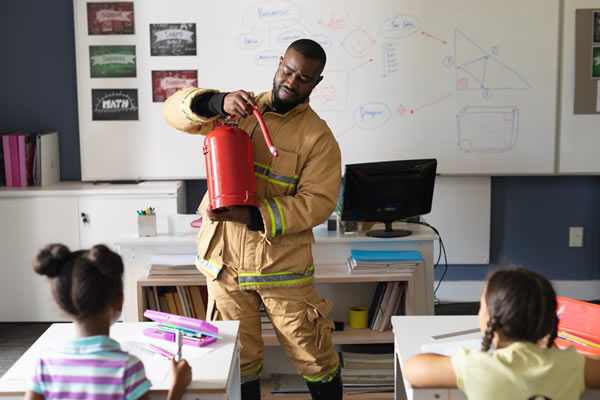
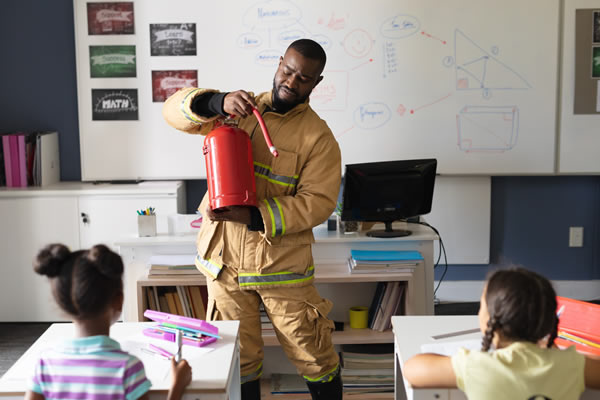
An example: the group to exit the most safely and efficiently earns points toward a lunch with your local fire department. (Most fire departments are more than happy to come to schools. Call yours to find out.)
2. Place at Least One Fire Extinguisher Every 75 Feet
This is the maximum for commercial or other buildings that contain a significant number of individuals. In some cases, you will want one fire extinguisher every 50 feet. The CDC gives recommendations depending upon the hazard class.
Please also consult your local laws and the school board to make sure your school is in compliance.
3. Additional Rooms that Require a Fire Extinguisher
It is imperative that any room that uses chemicals or electric machinery (such as wood or automotive shop classes and science rooms) have an extinguisher cabinet.
You should also have a fire extinguisher in the student lunchroom and teacher’s cafeteria/lounge.
Make sure you’re using the right dry chemical, wet chemical or carbon dioxide fire extinguisher for the materials that are in the area.
4. Have someone knowledgeable perform fire extinguisher inspections regularly. In a crisis, you’ll want to know they are in working order.
What if There is a Fire at School?
1. Stay Safe
You may think it goes without saying, but staying safe is always your priority if a fire should break out at your school. That means knowing when not to try to put out a fire.
Do NOT attempt to fight the fire, even if commercial fire extinguishers are available, if:
- You are not sure all students are out of the building yet. IMPORTANT: Getting students and impaired individuals to safety is the FIRST rule in case of fire. Then call 911.
- The fire is spreading quickly. If the fire takes up more than a few square feet of space or is spreading to the ceiling, floor or other walls, you are in danger. Get to safety and call 911.
- The room is smoky enough to impair visibility. Smoke inhalation is the leading cause of death from fire incidents.
- The fire may block, your only exit.
- The fire is so hot that you cannot get within approximately 10 feet of it.
2. Get Students and Staff Away from the Building
Remain calm and move students out of the building.
Once they are outside, get students and staff well AWAY from the building. Burning debris may fall, and in extreme cases, glass windows can blow out during a fire.
3. Call 911
Your fire safety procedure should include who will call the fire department. Don’t flood 911 with phone calls. Quickly find the person responsible for calling 911 and only call yourself if you cannot immediately find him or her.
4. ONLY Check Locker Rooms and Lavatories if SAFE
NEVER go back into the school building during a fire, but if you are not out yet and you are the person selected to do so on your fire safety procedure, check restrooms and locker rooms. These are two places that school fires often break out, according to experts.
Do NOT spend excessive time doing this, and do not check these rooms if the fire is nearby or cutting off your entrance/exit. Instead, get outside quickly and call 911 or make sure someone has already called 911. Let them know there may still be students in the building.
Ask the Fire Department to Come to Your School
During a crisis, panic can easily take over. However, the more you know, the less likely this is to occur.
Find out whether your school is willing to teach a fire emergency preparedness class. Obviously, what you teach students will depend upon their age and abilities.
Staff should be taught all fire safety procedures.
Your local fire department may be willing to come out and help teach the class. This makes an impact on students. Call and find out.
Teach Instructors to Use Fire Extinguishers
One last note about fire extinguishers: don’t think they’ll be easy to use if you’ve never done so before. Make sure you read all instructions. Even better, ask the fire department if they can come in and show the staff how to properly use the fire extinguisher.
Teach Fire Safety at the Student’s Level
Fire safety includes prevention, evacuation from the building, and the proper use of a commercial fire extinguisher for high school and college students.
For younger students, safe evacuation of the building and avoidance of smoke inhalation are the priority. NEVER expect a younger student, or any student, to handle a fire emergency before teachers do.
A Final Note on School Fire Preparedness
Remember: prevention and being prepared are the two keys to keeping students and staff safe in case of a fire emergency. Don’t get caught in a fire incident without the proper tools and knowledge. Being prepared means the difference between tragedy and a happy ending for students and staff at your school.
 Melanie Henson Copywriting
Leave a comment